

People often ask me which AI skill they should learn next.
Most of the time, that is the wrong question.
I had a conversation recently with someone considering one of the popular automation platforms. He has spent years in HR, working across talent acquisition, workforce planning, and people operations. Along the way, he learned Excel, Power BI, and enough Python to become comfortable working with data.
His real question was not about learning another tool.
It was whether someone with his background still had a place in a world increasingly shaped by AI.
The answer was yes. Not despite his experience, but because of it.
Technical skills rarely create value on their own. They create value when applied to a domain where someone understands the problems worth solving.
His HR experience gives him something many technical professionals do not have. He understands how organizations hire, how performance is measured, where approval processes slow work down, and where people operations create friction. Those are insights you cannot download from documentation or learn by completing a certification.
AI systems still need human judgment. They need someone who understands the business, the exceptions, and the decisions that cannot be reduced to rules.
Now imagine adding AI to that foundation.
Instead of becoming “someone who knows AI,” he becomes someone who understands HR and knows how to apply AI to it.
That combination opens far more doors than either skill alone.
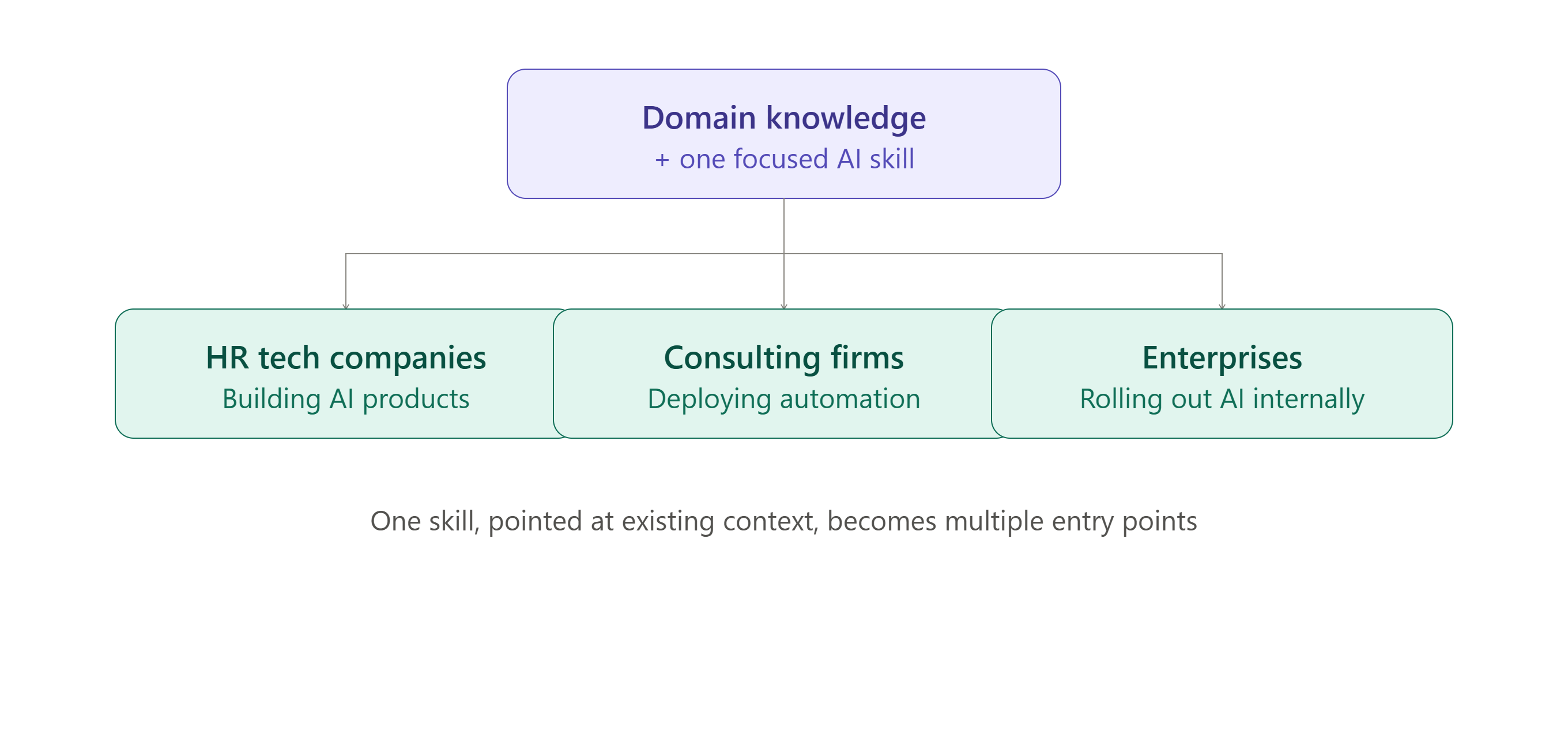
HR technology companies need product specialists who understand both workforce operations and AI.
Consulting firms need advisors who can help organizations redesign HR processes with automation.
Large enterprises need internal champions who can translate between technical teams and HR leadership.
The opportunity is not created by AI alone.
It is created by the intersection of AI and existing expertise.
This is where many career conversations miss the point. We focus on the newest models, the latest frameworks, and the next certification. Those things matter, but they are not where your advantage comes from.
Your advantage comes from combining technical capability with knowledge that is difficult to replace.
That is why I encourage people to spend less time asking, “What should I learn?” and more time asking, “What problems do I already understand better than most people?”
The second question is usually far more valuable.
Every industry has people who understand its language, workflows, regulations, and culture. Add enough AI fluency to those foundations, and entirely new career paths begin to appear.
Your move this week
Write down the domain knowledge you already have that most technical people do not.
Pick one AI or automation skill that sits closest to that domain, not the trendiest one.
Find three people or communities already working at that intersection and follow what they are building.
That’s all for today, see you in the next one.